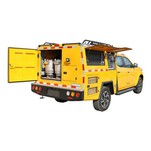

The internal layout of engineering emergency response vehicles typically adheres to the principle of functional zoning, aiming to optimize space utilization and operational efficiency. Communication equipment is frequently positioned near the driver's area to facilitate easy operation by the crew; heavier equipment (such as generators) is usually situated at the bottom of the cargo compartment to ensure vehicle stability during transit; commonly used small tools are often stored in multi-tiered drawer cabinets located near the doors for quick access; meanwhile, bulky and frequently used equipment (such as water pumps) is securely anchored in the central section of the compartment.
Specific vehicle models feature layouts tailored to their particular functions. For instance, the Amp Heavy-Duty Emergency Rescue Vehicle features a driver/crew cabin at the front, a Palfinger truck-mounted crane (with a maximum lifting capacity of 6.2 tons) in the middle section, and a tool compartment at the rear. The vehicle's tail section is equipped with access hatches for equipment, lighting masts, and other fixtures, while also integrating devices such as a front-mounted winch and an onboard forklift. Drainage emergency vehicles-such as the BD600 and ZLF5040XXHBD models-arrange their equipment on racks mounted along the sides and rear of the vehicle body [6]. The Shuailing Double-Row Light Truck Emergency Vehicle features an orange-yellow body and a double-row cab capable of seating five occupants; it is powered by a JAC 4DA1-2C engine (120 horsepower) and features a cargo box measuring 3200 mm by 1800 mm [7]. High-flow drainage emergency vehicles-such as the Kama (800 m³/h) and Dongfeng Tianjin (3600 m³/h) models-typically integrate core components-including diesel generator sets, portable submersible pumps, control systems, and drainage hoses-within the vehicle's cargo compartment.
The interior of an engineering emergency response vehicle's cargo compartment is typically outfitted with key equipment such as water pumps, generators, 3000W power inverters, and vehicle-mounted power take-off (PTO) systems. Large-scale equipment can be loaded into or unloaded from the compartment via an optional articulated crane located at the rear of the vehicle, or through hatches on the roof. The cargo body itself typically features a fully sealed structure constructed from high-quality cold-rolled steel plates, reinforced with an internal bent-frame skeleton, and fitted with aluminum alloy rolling shutter doors; this design provides comprehensive protection against rain, corrosion, fire, and rust. The interior ceiling of the vehicle cabin features a lighting system; select models are additionally equipped with safety and technical support facilities such as retractable lighting systems, vehicle grounding, lightning protection devices, and fire extinguishers. Furthermore, optional configurations-including luggage racks, access ladders, warning lights, and hydraulic outriggers-are available to meet specific requirements.