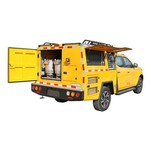

Vehicles can be categorized by function into several types, including drainage and flood control vehicles, power repair vehicles, emergency rescue vehicles, fire trucks, and road clearing/rescue vehicles. For example, emergency rescue vehicles utilize a compact design for earthquake rescue missions; power repair vehicles are equipped with specialized electrical repair tools; and fire trucks are further subdivided into general-purpose and chemical rescue models. Drainage and flood control vehicles/tunnel rescue vehicles are used for tasks such as drainage and tunnel clearing in disasters like floods and landslides.
Based on load capacity and size, vehicles can be divided into light-duty rescue vehicles (such as those using Qingling chassis) and heavy-duty rescue vehicles (such as those using Sinotruk Howo, Dongfeng Tianjin, and Isuzu chassis). Heavy-duty vehicles are suitable for large-scale operations such as field repairs of petrochemical pipelines.
Based on power type, vehicles can be divided into traditional fuel-powered rescue vehicles and new energy-powered rescue vehicles. With technological advancements, the proportion of new energy (pure electric and hybrid) emergency rescue vehicles is continuously increasing. These vehicles feature low noise and extended driving range (e.g., some pure electric models can achieve a range of 300-400 kilometers), making them suitable for operating environments requiring quiet operation.
High-flow-rate drainage emergency rescue vehicles are an important subcategory of engineering emergency rescue vehicles, also known as engineering rescue vehicles, flood relief vehicles, flood control vehicles, drainage vehicles, and drought relief vehicles. These vehicles are typically equipped with diesel generator sets, high-flow-rate portable submersible pumps, and intelligent control systems. They are specifically designed for urban flood control and drainage, agricultural drought relief, and emergency drainage scenarios, with drainage capacities ranging from hundreds to thousands of cubic meters per hour (e.g., 800 m³/h, 3600 m³/h).